The Exam That Keeps Breaking India's Doctors
On May 12, 2026, the NTA cancelled NEET-UG for 22 lakh aspirants after a coordinated paper leak. This is not a one-time failure — it is what happens when an entire nation's medical future rests on a single exam, a single agency, and a system that keeps choosing convenience over accountability.
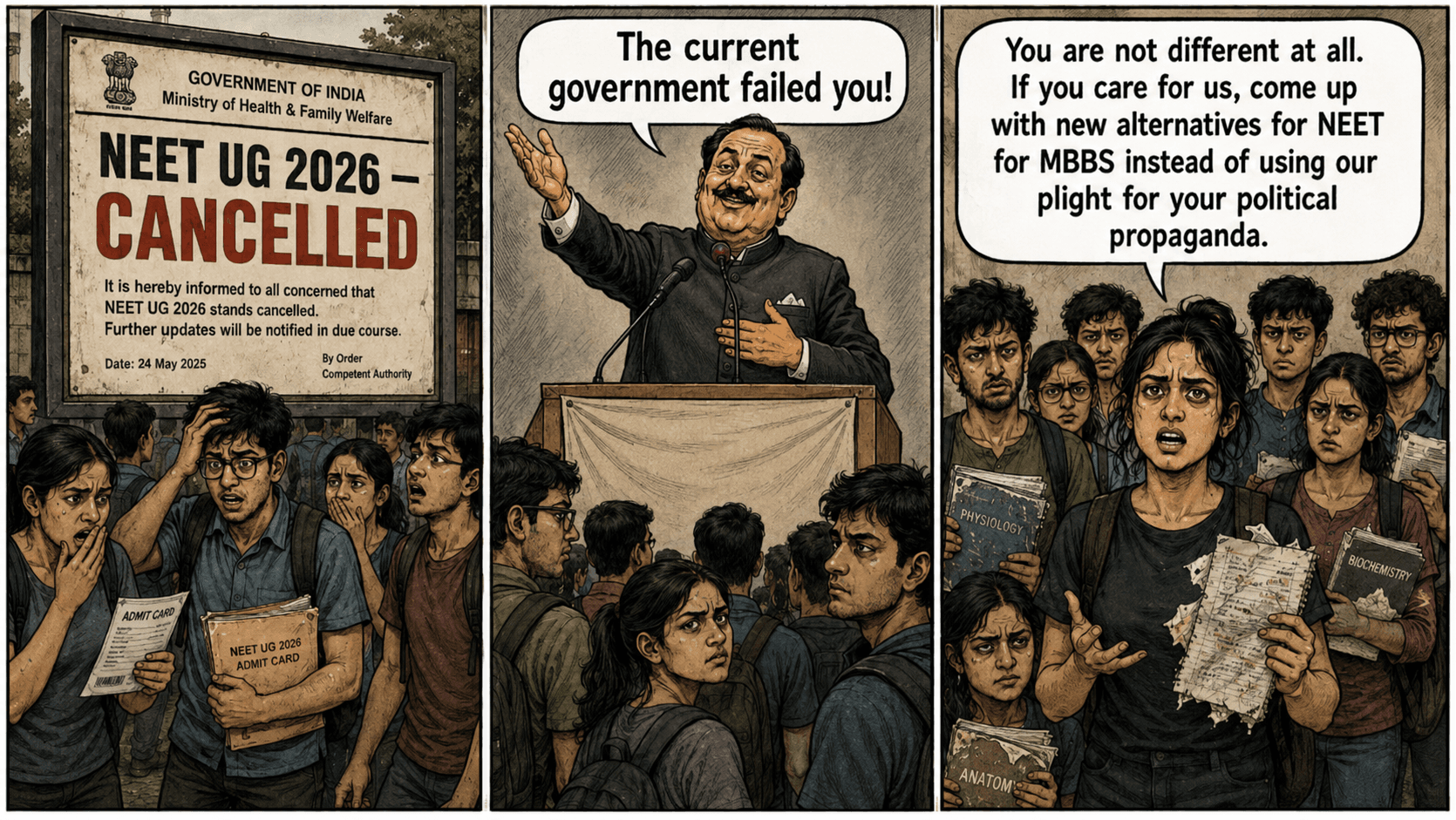
When the system designed to produce healers becomes the wound itself
What Happened
On May 3, 2026, over 22 lakh students across India sat for NEET-UG — the only gateway to an MBBS degree in the country. Nine days later, the National Testing Agency cancelled it entirely.
A chemistry lecturer with insider access had leaked the question paper, dictated answers at his Pune residence, and distributed them through encrypted Telegram and WhatsApp groups to students who paid between ₹2 lakh and ₹5 lakh each. The CBI is now investigating a multi-state network spanning Maharashtra, Rajasthan, and Haryana. The re-examination is scheduled for June 21, 2026.
Ritik Mishra, a third-time aspirant from Lakhimpur Kheri, did not wait for that date. The cancellation announcement was enough.
Why It Happened
India made a structural choice in 2020 — one exam, one agency, every medical seat in the country. The logic was standardisation. Eliminate capitation fees. End state-level corruption. Create a level playing field.
What it actually created was a single point of failure with 22 lakh people standing on it.
The NTA has now presided over catastrophic examination failures in consecutive years. A Parliamentary Committee found that at least 5 of 14 major exams conducted by NTA in 2024 faced critical failures. A reform panel was constituted after the 2024 crisis. Its recommendations were acknowledged and forgotten. The ₹448 crore surplus the committee suggested using to build government-owned testing infrastructure remains unspent on that purpose.
Meanwhile engineering students have JEE, BITSAT, VITEEE, SRMJEEE, and a dozen state-level options. If one collapses, others hold. Medicine has nothing equivalent. That asymmetry is a policy choice — and students are paying for it with years of their lives.
Why It Matters
During COVID-19, India's healthcare system did not just face a virus. It faced the consequences of decades of underinvestment in medical human capital. Over 700 doctors died in the line of duty. Hospitals ran out not just of oxygen and beds — but of people.
Specialists were so scarce that hospitals drafted doctors nearing retirement into COVID wards because there was nobody else. India needs more skilled doctors, more medical researchers, more allied health professionals — urgently and structurally.
Every year NEET collapses is a year that pipeline gets delayed. Every aspirant lost to despair or dropout is a compounding deficit the country will feel a decade from now, in some hospital, in some emergency, when there is again nobody left to call.
The Causal Take
The politicians who arrived at press conferences after May 12th are not wrong that the system failed. They are wrong to pretend they had nothing to do with it.
The 2024 reform panel reported to the same Parliament. The NTA surplus sat in the same government's accounts. The Public Examinations Prevention of Unfair Means Act, 2024 — passed with much fanfare — did not prevent a single thing in 2026.
Outrage after a leak is the cheapest form of concern available. What these students need is not a press conference. They need a parallel entrance architecture. They need distributed testing infrastructure. They need an admission ecosystem that does not place 22 lakh futures on one agency's ability to secure one envelope.
India built that for engineers. It chose not to build it for doctors.
That choice has a cost. Ritik Mishra paid it first. The country will pay the rest later.
One Line Closer
The SSC Memo proves you survived school. What India builds for its doctors after this — that will prove whether the system deserves them.
Enjoyed this post?
Follow The Causal Observer to get notified of new posts.
Do you intend to write blog posts yourself?
Click hereHave a Question?
Please log in to ask the author directly.
Comments
No comments yet. Be the first to share your thoughts!